Services
At Asset Peak Performance we
believe that every job can be broken down to small pieces of to do tasks and the
First thing to do is to go down to earth, list your assets, categorize them, and
determine the type of maintenance practices suitable to be applied for each
category.
Based on our experience we
have listed the Maintenance practices used by the different industries and then
we show our services and added value.
A. Maintenance
Practices
B. Vibration
Analysis
C. Bearing Failure
Analysis
D. Bearing Mounting
and Dismounting
E. Bearing
Lubrication Management
F. Laser Alignment
G. Field and
Workshop Dynamic Balancing
A. Maintenance
Practices
I.
Breakdown maintenance
•
Definition:
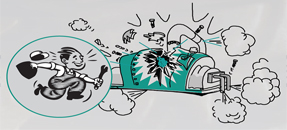
You fix the machine when it breaks.
•
Results:
a)
Downtime is common
b)
Secondary damages are
COSTLY
c)
Control is lost over
production
II.
Preventive maintenance
•
Definition:
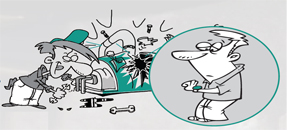 You perform regular
overhauls based on a scheduled time so that the machine will not fail.
•
Results:
a)
LESS COSTLY than breakdown
maintenance
b)
Repair intervention is based
on time
c)
Many times you fall into the
breakdown maintenance because you are basing your practices on time and not on
operating conditions of the machine.
III.
Predictive maintenance
•
Definition:
You don’t fix it if it will not breakdown.
•
Results:
a)
MUCH CHEAPER than preventive
maintenance
b)
Repair intervention is based
on operating conditions
c)
 This is the only way to look
into the future since machines express their pain before failing. Their problems
have symptoms. Many technologies help us interpret these symptoms to understand
their causes. We can rely on:
o
Vibration analysis
o
Oil analysis
o
Thermal imaging
o
Motor current analysis
o
Ultrasound
IV.
Proactive maintenance
•
Definition
You need to anticipate and solve the problems even before they occur.
•
Results:
a)
THIS IS THE ONLY WAY TO
EXTEND THE LIFETIME OF THE MACHINE
b)
After checking symptoms
using predictive maintenance, we perform root cause analysis to treat and solve
the cause.
c)
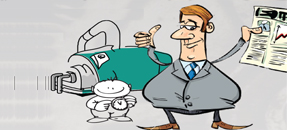 Experts should go through
details like the following few points:
o
Purchase specifications
o
Installation procedure,
levelling, precision alignment, …
o
Acceptance testing
o
Routine maintenance
procedure, tools,…
o
Condition monitoring
technologies
d)
LOWEST COST
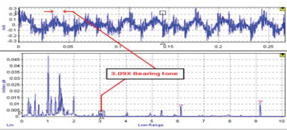
B. Vibration
Analysis
I.
Advantages:
1.
Determine the severity of
the problem if it exists
2.
Determine the source of the
problem
3.
Determine the type of the
problem
4.
Determine the way for
solving the problem
5.
Determine the remaining
lifetime of the machine before breakdown
II.
 Applications:
1.
Electric motors
2.
Pumps
3.
Fans
4.
Gearboxes
5.
Turbines
6.
Compressors
7.
Engines
8.
All rotating components
III.
Return On Investment Calculations to show savings
from:
1.
Mechanical components cost
2.
Secondary damages
3.
Energy consumption
4.
Unexpected production
stoppage
5.
Labor cost
We take the right actions at the right time to avoid
these costs.
C. Bearing Failure
Analysis
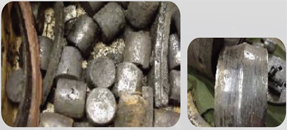
The bearing is subject to all loads generated from the machine, the process,
induced vibration from the surrounding …
Our experience leads us to identify patterns which can tell us the root cause of
the failure.
I.
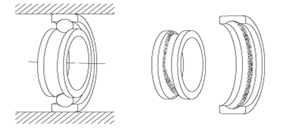 Every type of problems has its
own unique signature that help us know if this is:
1.
Misalignment
2.
Eccentricity
3.
Unbalance
4.
Type of lubrication
5.
Ingress of contamination
6.
Current fluting
Above
problems can be treated to avoid their re-occurrence.
D. Bearing Mounting
and Dismounting

I.
We prepare a file specific for each equipment for
mounting and dismounting bearings procedure.
Fail to plan is plan to fail; we plan our activities and conceive
procedures for evaluation.
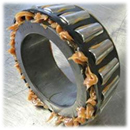 E. Bearing
Lubrication Management
I.
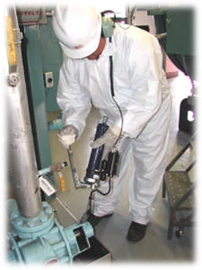
Studies
SKF
studies showed that:
–
36% of bearings fail due to bad lubrication
–
14% of bearings fail due to contamination
This is
50% of bearing failure causes
II.
Factors leading to successful lubrication:
–
Right type of lubricant for the application
–
Lubricant quantity
–
Re-lubrication Intervals
–
Re-lubrication procedure
–
Lubricant performance monitoring
F. Laser Alignment
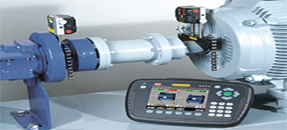
I.
Applications:
1.
Horizontal shaft alignment
2.
Vertical shaft alignment
3.
Soft foot
4.
Thermal growth compensation
5.
Cardan shaft
6.
Machine train
7.
Belt and chain drive
8.
Straightness
9.
Flatness
10.
Squareness
11.
Parallelism
12.
Spindle alignment
II.
Typical problems arising from misalignment are:
1.
Lost production
2.
Leaking seals
3.
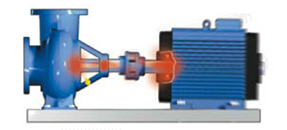
Increased vibration
4.
Higher energy consumption
5.
Bearing failure
in less than one year
6.
Shaft breakage
7.
Coupling wear
8.
Quality problems
9.
Labor cost
Read the Study and ROI made on
One Electric Motor after Alignment
G. Field and
Workshop Dynamic Balancing
Machines that have been
precision balanced run longer and cost less to run
I.
Unbalance Facts:
1.
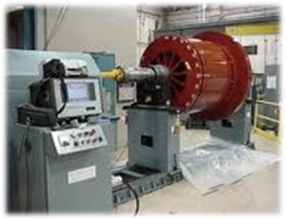 Unbalance causes fatigue and
reduces the life of bearings.
2.
Unbalance can make looseness
and resonance conditions far worse.
3.
Unbalanced rotors generate
destructive vibration to machinery components leading to:
o
Unavoidable breakdown
o
Damaged machinery structure
o
Damaged mechanical
components
o
Excessive additional energy
consumption
o
Production stoppage